2014: A Piece of Heaven

//The World Came to Me (6)//

I gotta confess. The only reason that brought me to this concert was the Adagio from Mozart’s Clarinet Concerto. I have this CD of clarinetist Robert Marcellus’ 1961 recording with George Szell and the Cleveland Orchestra with me for decades. And this recording has always been my savior whenever I desperately need to find some inner peace. Teacher once said, “You will never find an interpretation that matches what you have in your head.” There is an untouchable & out-of-the-world quality to this exquisite piece of music. So with a guarded expectation, I went to this concert.
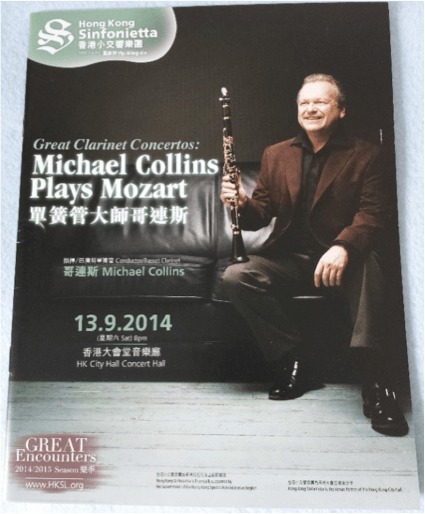
PROGRAM

Mozart / The Marriage of Figaro Overture, K492
Mozart / Clarinet Concerto in A, K622
Mozart / Serenade No. 10 in B-flat, K361, “Gran Partita”

It was a delight watching Michael Collins’s clarinet dancing and twirling, making Mozart’s music come to live. Teacher was right though. I will probably never see an interpretation that matches what I have in my head. To me, Robert Marcellus’ recording is still the closest version thus far.

The extra bonus I got from that night was the discovery of the oboe. I never really paid much attention to the oboe in the orchestra. But that night when Hong Kong Sinfonietta then-principal oboist Marrie Rose Kim played in the “Gran Partita”, I was like “Wow!”. Her oboe was dancing and fencing with Michael Collins’ clarinet. And it was so beautiful and powerful. Since then I always looked for her on stage in Hong Kong Sinfonietta concerts.

Here’s a review of the concert in South China Morning Post: https://www.scmp.com/lifestyle/arts-culture/article/1593158/great-clarinet-concertos-michael-collins-plays-mozart.

And a more recent (2019) performance of the Mozart’s clarinet concert by Michael Collins with the London Mozart Players:
 

2014: Solo Journey

//The World Came to Me (5)//

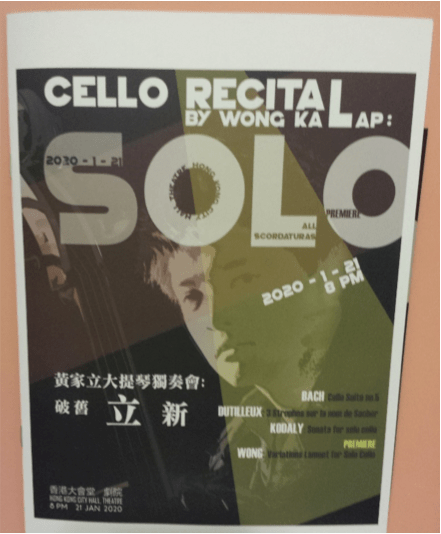
Sometimes I do wonder if it was fate. So, here’s the story. I was trying to figure out how to write this next episode. As I surfed the web to see what this cellist Ka Lap Wong has been up to lately, I came across an interview article on his upcoming concert that will be held in a few days (in 2020)! I immediately jumped into the ticketing site to check the prices and availability. There was a single seat available right in the middle of one of the front rows. But it cost $380! I hesitated. I was not in a good financial state and $380 was a lot of money…

I kept debating with myself that night and the next day. “It’s expensive. But he is going to play Bach Cello Suite No. 5 in a tuned down cello setting. What would be his approach?” The tuned down Bach Cello Suite No. 5 became my favorite Suite after attending British cellist Colin Carr’s Bach Suites concert in 2017. The curiosity was killing me, so I put my foot down and bought the ticket.

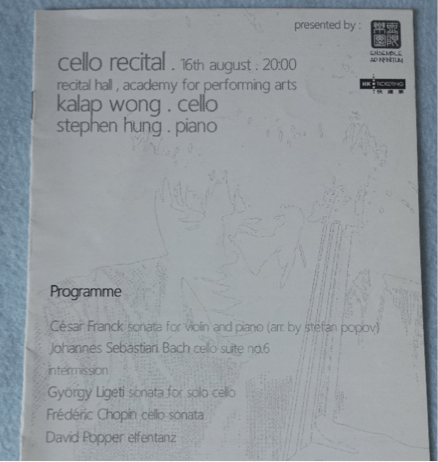
Before I get to the 2020 concert, let’s rewind. At the very beginning of my cello learning, Ka Lap Wong was one of the teachers in my group class. In 2014 I went to his concert, also out of curiosity to see how he was doing. The program at the time was quite technically challenging.

2014 PROGRAM

César Franck  / Sonata for Violin and Piano
J.S. Bach  / Cello Suite No. 6
György Ligeti / Sonata for Solo Cello
Frédéric Chopin / Cello Sonata
David Popper / Elfentanz

Five years later, this was the program of the 2020 concert:

2020 PROGRAM

J.S. Bach  / Cello Suite No. 5
Henri Dutilleux / 3 Strophes Sur Le Nom De Sacher
Zoltán Kodály / Sonata for Solo Cello
Ka Lap Wong / Variations Lament for Solo Cello

I am not technically there yet to try the whole Bach Suite myself. So far, I have only played the Sarabande. So at least I am a little more familiar with that. My first reaction to Ka Lap’s interpretation of the Sarabande was “One can do THAT?!”. Then I immediately reminded myself what a lot of masters have said. Everyone has his or her own interpretation of the Bach Suites. And the key thing is whether the player himself or herself is convinced of such interpretation. Just then I relaxed and very much welcomed an opportunity to experience his interpretation. A good lesson learned.

As for the other pieces, I have to confess that I am not a big fan of contemporary music as I find it quite difficult to understand. But surprisingly I didn’t find Ka Lap’s playing boring at all. And his own composition was full of sincerity. Actually, “sincerity” was not a good description. When I looked back at the notes I scribbled on the back page of his 2014 concert program booklet, one of the words I wrote said it all – “Heart”. And this was exactly what I saw in this 2020 concert as well. I noticed a self-acknowledgment gesture of his after completing each piece. My impression over the years was he has worked very hard on what he believes in. It was inspiring and comforting to see a cellist putting his heart and mind into a lifelong soul-searching journey. I am not alone.

2014: Out of Body Experience

//The World Came to Me (4)//

Since then I started making a habit of looking up any interesting upcoming concerts by regularly browsing music organization websites, ticket booking sites, and various cultural calendars. And then I spotted this…  Edicson Ruiz playing Dittersdorf’s Double Bass Concerto No. 2. “Double Bass? Is that a big brother of Cello? What does it sound like as a solo instrument?” I told Teacher I bought a ticket:

Me: Actually… is it beneficial to go to “non-Cello” concerts?
Teacher: Of course! Go!
Me: And I got a front row seat ticket!
Teacher: Err…  With Double Bass it is usually better to get seats that are a little further away from the stage because of its sound projection. You may not hear much in the front row.”
Me: Oh… Crap!

PROGRAM

Richard Strauss / Don Juan, Op 20
Dittersdorf / Double Bass Concerto No 2 in E-flat
Mozart / Symphony No 35 in D, K385, “Haffner”
Richard Strauss / Till Eulenspiegels Lustige Streiche, Op 28

A video about the event posted by the Hong Kong Sinfonietta

As I sat anxiously in the front row seat worrying that I might not hear much, this guy with a warm persona walked up on stage and planted this humongous instrument right in front of me! I looked up in awe, not just because of its sheer size but the wood looked old and full of character. And then the magic began.

I swear. I had never ever experienced something like this. He was swaying his body fluidly while he was moving his bow. But his voice was right here, in front of me from this wooden box! I kept looking at him and then at the Double Bass, then at him again, and the Double Bass again. I just couldn’t believe my eyes and my ears. How was it possible? It was mesmerizing. I was hooked.

I reported back to Teacher at our next lesson with an excitement like a little kid who just saw Santa Claus. And you know what my conclusion is? “Don’t even dare to touch a Double Bass unless the big guy up there told you to do so.”

Edicson Ruiz has a very fascinating background. Here’s an interview in Rehau’s corporate magazine Unlimited where he described his upbringing in detail: https://www.rehau.com/za-en/corporate-information/press/unlimited/unlimited-7-south-america/democracy-in-the-orchestra.

And not to be missed, Edicson Ruiz posted a YouTube video where he played the Bach Cello Suite No. 1:

2014: 1 + 1 + 1 + 1 + 1 + 1 Is Greater Than 6

//The World Came to Me (3)//

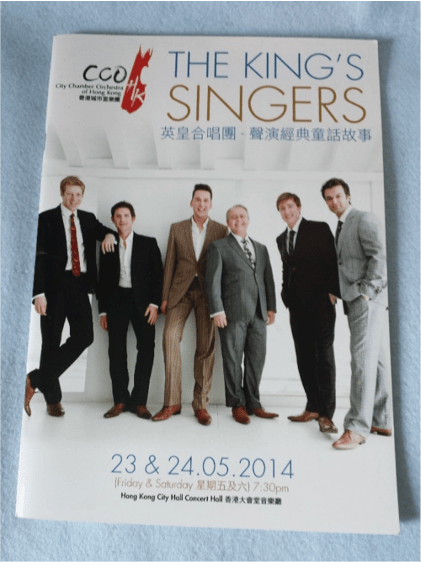
Then I saw another interesting poster in the subway station. “The King’s Singers? This is not the King’s College Choir since these are grown men. Who are they?” Out of curiosity, I bought a ticket.

PROGRAM

John Rutter‘s The Wind in the Willow
Traditional English Folksongs
Triumphs of Oriana and Trionfo di Dori
Cole Porter Songs from The Great American Songbook

I couldn’t believe my eyes and ears during the night of the performance. They were SO good. I had never heard such a mix of voices like that. And how on earth could they sing like this without any instrumental accompaniment? (Yeah. That’s the first time I learned the word “Cappella”) What they created was more than just 6 voices together. So alive. So captivating. They were not doing this just as a job. They really enjoyed sharing the moment with the audience.

This performance review in the South China Morning Post (https://www.scmp.com/lifestyle/arts-culture/article/1519679/review-kings-singers) reminded me of the fantastic encore they did for the Hong Kong audience by singing Frances Yip’s Shanghai Beach in Cantonese!!! It was unbelievable!

After the concert, I went on the Internet to find out more about this group: its history, performances, interviews, etc.

The King’s Singers concert was a true gift for me as I can still feel the synergy created by these dedicated and passionate talents today.

The Research

//Checkpoint (2)//

While learning the notes and coming up with the fingerings to play the piece, I did some online research on the side as well. From looking at the comments people posted under that YouTube video, I learned that the piece was actually the “Prelude”  from Shostakovich’s film music The Gadfly Suite, Op. 97a.

It’s the first time I had ever listened to a complete film music score in one go. Although the “Romance” from this suite is the most popular piece, the “Prelude” still remains as my favorite to this day.

But… what on earth is “Gadfly”? After some Googling, it turned out the film was based on the novel The Gadfly by Irish writer Ethel Voynich. So I downloaded the novel to my Kindle and made it a mission to read the whole novel the following weeks.

Here’s a 2017 BBC article by Benjamin Ramm about this novel (see reference 1).

It contains a good summary of the story:

“The Gadfly is set in Italy during the revolutionary ferment of the 1830s and ‘40s. The protagonist is a young Englishman, Arthur Burton, who moves to a Catholic seminary after the death of his mother. There he becomes devoted to his guardian and mentor Montanelli, who, unknown to him, is also his biological father. In the company of his childhood sweetheart Gemma, Arthur becomes involved in the Young Italy movement fighting Austrian imperial rule. But he unwittingly betrays his comrades, after his private confession is relayed to the police. He then discovers his family secret, and loses all faith in the church.

Arthur feigns his suicide and escapes to South America, where he endures years of torture and degradation. He returns to Italy in the guise of ‘The Gadfly’, a fearless and revered revolutionary whose true identity is masked. After his capture, he is visited by Montanelli, now a cardinal, who offers him a lifeline. But Arthur, unforgiving and uncompromising, demands that his father renounce the church. Montanelli refuses and condemns his son to death. Arthur, now a Christ-like figure, commands his own execution and forgives the firing squad. At the Corpus Christi mass, Montanelli denounces God’s sacrifice, then dies of a broken heart.”

I don’t even remember how long it took me to finish the novel as I somehow found the writing to be a bit dry, despite many good reviews from other readers. After I finally finished reading the novel, I spent over an hour with my teacher going through the storyline. We dissected the personality of the main character Arthur and his relationships with his father and his love interest. Teacher supplied some historical background and explained the motives behind the actions of the character. “Now, why on earth my teacher always loves to talk about history of this and history of that, I will never understand. It just bores me to death.” Although my teacher liked the story, at the end of our lengthy discussion I still had a hard time liking Arthur and the choices he made.

If I couldn’t relate to or even like the story, I knew for sure I wouldn’t be able to interpret it through music. But my teacher always says it is important for us as students to have a story behind the music we play. “So, now what?”

Reference:
1. BBC article by Benjamin Ramm, 2017.
http://www.bbc.com/culture/story/20170119-the-irish-novel-that-seduced-the-ussr

How It All Began

Prologue

October 14, 2013. That’s the day when I played cello in front of strangers for the first time at a cello student concert. And why am I writing about this now, almost 6 years later? Strangely enough, to this day, I am still discovering more and more about what I have gained from this experience. Before my memory fails me, I’d better write this down as a keepsake. OK, actually my teacher has been nagging me about the benefits of keeping notes of my study too.

//Checkpoint (1)//

How It All Began

This all started, about 6 months before the concert, when my teacher asked me if I would be interested in participating in the concert. To be honest, performing in public has never been my forte. But I felt I needed a checkpoint at that stage of my cello study. Considering my teacher would be playing together with me on stage, this seemed doable. So during the week after, I spent hours on YouTube every night looking up duet pieces that I might be able to handle technically. But more importantly, a piece that touched me. And that’s when I came across this video, Prelude by Dmitri Shostakovich performed by 2Cellos.

Next, I needed to find the score. At the time I was only able to find a copy of the violin version, Prelude from Five Pieces for Two Violins and Piano. Then some folks in a music forum mentioned one could just transcribe the violin version into cello version by moving it one octave down.

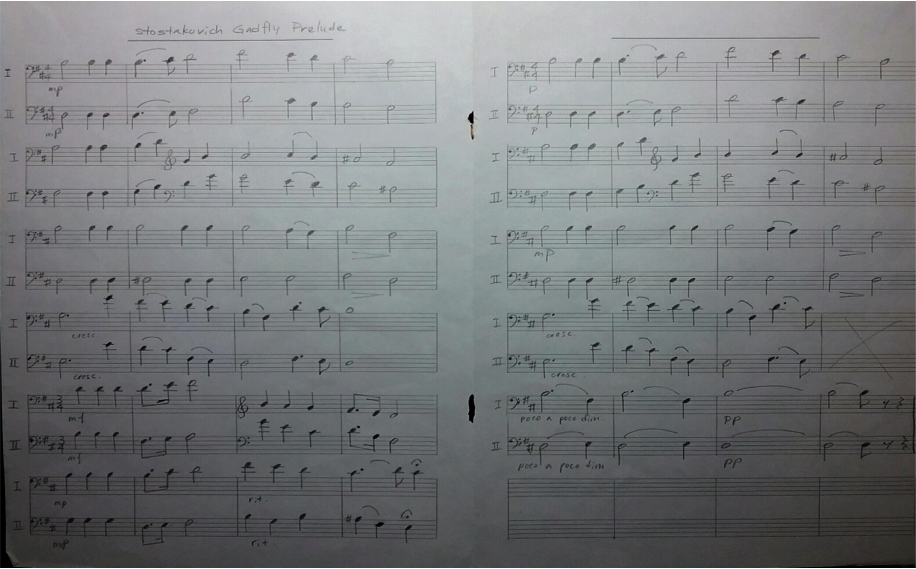
So I went to a nearby stationery store and bought a manuscript notebook for 5 dollars. First, I used a pen to draw the vertical lines to separate the bars and to group the First and Second cello sections. Then I used a pencil to draw each note. It took me several hours that night to finish this.

Figue 1. Transcribed Score

Figure 1. Transcribed Score

With the score in hand, I eagerly went to my next cello class, and showed my teacher the 2Cellos video and the hand-written score. He agreed it was a good choice. But he pointed out that the First cello part didn’t need to be moved down by one octave as it would not sound compatible. “Oops!” Then he suggested I played the Second cello part. “Oh…” Needless to say, I was a bit disappointed. But believing my teacher must have a good reason, I reluctantly replied “O…kay” and moved on.