What Have You Done to Him?

//The Cello Lesson Comedy Show (9)//

The Price Ranges and Magic of Cello Bows
Posted by Locomotive Music (2020)

Many years ago when I first met him…

Me: What have you done to him?
Teacher: Huh?
Me: Him. [Pointing to the cello that Teacher let me use in class.] It feels like he went through a lifetime of hardship.
Teacher: Oh, yeah. He had quite a journey with me when I was a music student.

Every now and then I see him in class.

Me: Hi! Haven’t seen you for a while.
Cello: ^_^
Me: He looks dusty. Why don’t you clean him up after each use?
Teacher: Yeah, yeah, I will.

***

Me: What have you done to him?
Teacher: Huh?
Me: He sounds weird. [Scanning his body and looking through the F-holes for clues.]
Teacher: I am experimenting with different strings on him.
Cello: >_<
Me: He doesn’t like them.

***

Me: Good to see you again!
Cello: * € *
Me: How come he sounds like he has a stuffy nose?
Teacher: Oh, yeah. I haven’t played with him for a while.

***

Cello: Ö
Me: What the… [Checking the label on his tummy to be sure it is really him.] What have you done to him AGAIN?
Teacher: Huh?
Me: He doesn’t sound like him. Did you lend him to someone else again?
Teacher: Yeah.
Me: He has done so much for you over the years. Why can’t you just treat him better? Hasn’t he suffered enough from your abuse?! *Death Stare*
Teacher: Well, it builds his characters.

A cello or bow does not need to be expensive to have a life with distinct characters.

Easier Is Not Easier

//The Cello Lesson Comedy Show (8)//

Like most music students, I resisted practicing Etudes. They are difficult and boring.  Only in recent years that I finally gave in and picked up the infamous Alvin Schroeder’s 170 Foundation Studies for Violoncello. I usually just flip through the pages, then randomly settle on certain page to work on. So just like any other normal day, I flipped through the pages again. Then I froze.

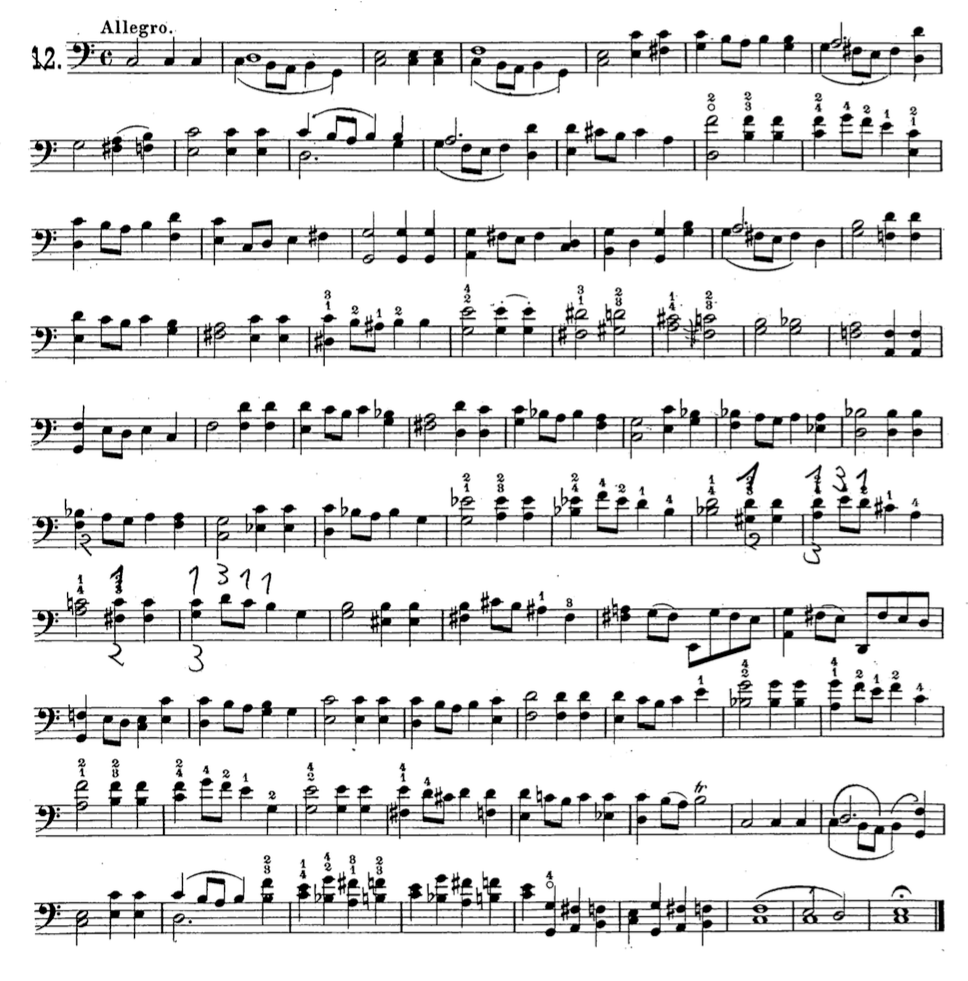
Me: [Pointing to Dotzauer Op 120 No. 12] This was the one you asked me to play many years ago and I could never get It to work. Why did you give me this instead of this? [Flipping to the page of Dotzauer Op 120 No. 7]

Teacher: It makes perfect sense. No. 12 is an easier piece to learn double stop.

Me: It makes no sense. No. 12 is much harder than No. 7 to work with. Back then when I listened to you, no matter how hard I tried, I just couldn’t get through No. 12.   

Teacher: But No. 7 is technically more difficult.

Me: But No. 7 makes more sense. How can I work on something if it doesn’t make sense? Maybe it’s more difficult, but so what? If I can’t play the slur, then I focus on getting separate bowing to work first. If I can’t play double stop yet, then I focus on getting the upper and lower lines to work separately first. At least this piece gives me so much more to work on.

Teacher: *Head Shaking* Be my guest…

Friedrich Dotzauer, 18 Exercises for Cello, Op.120 (Upper: No.7 ; Lower: No. 12)
Publisher: Steingräber Verlag, Leipzig, n.d. (ca.1900). Plate 825.
https://imslp.org/wiki/Special:ReverseLookup/57213


PS. I have been working on No. 7 for ages now (if not for a year then at least 6 months). I still have a long long way to go. True that I have yet to be able to play the piece decently, but it has been more enjoyable (and painful) to experience the tiny discoveries every week or 2.

Newton’s Candle

//The Cello Lesson Comedy Show (7)//

Immediately after walking into Teacher’s studio…

Me: I got a lightbulb moment yesterday!

Teacher: Uh Oh…

Me: Up-bow and Down-bow strokes are the SAME! Why didn’t you tell me?! Do you know how much pressure was lifted off me when I realized this?!?!

Teacher:  Hah? They are not the same. When you do the up-bow, you…

Me: Look at Maisky’s up-bow and down-bow strokes. They look the same. They sound the same. So they ARE the same!

Teacher: Well, the goal is to make them sound the same.

Me: No! Think of it this way…[I stood up and hopped once.] We are here. [Then I hopped to my right.] But in the second dimension, Up and Down are the same thing and that is the only thing that exists. Nothing else exists. It’s as simple as that.

Teacher: But you have to work on the strokes differently!

Me: That’s not my problem. It’s his problem. [Pointing at my right hand]

Teacher: (“Please! Someone call the nuthouse!!!”) 

By now you probably wonder why I named this episode “Newton’s Cradle”. Newton’s Laws of Motion may be considered Science. But their beauty is pure Art in Nature. Watching Mischa Maisky play Grieg Cello Sonata in A-minor, I could envision these laws of inertia, energy, momentum, and action-reaction at play, not just within a single sonata movement but even in between movements. It’s what lying under the facade that matters.

Newton’s Cradle with a High-Speed Video Camera
Posted by Jeff Register (2012)

Where Should I Go?

//Checkpoint (5)//

We received notice from the music school regarding the arrangement on the day of the concert. There will be a rehearsal at the venue in the morning, then free time in the afternoon before the actual concert in the evening. My immediate reaction was “Oh, no… Where can I go that afternoon?”

Going home would not be a good option for 2 reasons. For one, it would drain quite a bit of energy and concentration hauling the cello back and forth even if I took a taxi. But more importantly, I would be at risk of arriving late at the concert if there was a traffic jam.

What about sitting in a coffee shop or hotel lobby? It’s an economical and logical solution for sure. But I quickly threw out that idea as there would be too much distraction in the surrounding.

As the day of the concert was getting near, I got more anxious not having a solution. I did have another idea but it just seemed crazy. I finally explained this idea to my mom and surprisingly she supported the idea. So at 11 pm before the big day, I made an online room reservation at a hotel which was about 15-minutes walking distance from the venue. Now I had a place to rest during that afternoon before the concert.

I asked my mom to go with me to the rehearsal but not to the actual concert at night. I wanted her to see for the first time what I have been doing for the past few years. And I needed someone to watch over my cello if I needed to step away for a while. But her attending the actual concert would cause more anxiety and distraction for me.

You Never Listen

//The Cello Lesson Comedy Show (5)//

“You Never Listen.” I am pretty sure this pops up in Teacher’s head often whenever he was dealing with me. But there was only one time when this flew out of his mouth before he could stop it.

Me: I am going to try out some bows when I visit this music shop during my trip.

Teacher: (Trying to put on a serious face) Do NOT buy ANYTHING!

At the store, the very helpful and knowledgeable consultant gave me at least 20 bows to try. My cello playing was so bad that I couldn’t even play “Twinkle Twinkle Little Star”. But for some unknown reason, my right hand kept putting aside this one particular octagonal bow. The consultant was so nice that he used the octagonal bow and another bow he recommended to play some pieces for me. I froze when he used the octagonal bow. I have never ever heard such a dark sound like that before. I was mesmerized. I just couldn’t leave without it.

Upon return from my trip, I kept silent about the purchase. Several weeks later after I was sure about my purchase, I finally told Teacher.

Me: Mm… actually…  I bought a bow during my trip.

Teacher:  I knew it! You NEVER listen.

Me: *Squirming* I know it’s an octagonal bow with limited usage. And I know I don’t even have the technical skills to use a bow like this anytime soon. But I couldn’t help it. It feels like a Devil’s bow. Well… at least it is in the price range of the next upgrade you told me before… Granted you meant “next” as in many years down the road…

Teacher manhandled the bow in his hands for a little while, then took out his cello and played with the new bow for a while. I was getting myself ready for a harsh lecture from him. Then he looked up.

Teacher: (Smiling widely like a kid in the candy store) This bow is a SUPER bargain!

Me: *Eye Roll* And you told me not to buy anything…

PS. This was the session when Teacher played Bach’s Arioso so beautifully that I wanted to cry at every note.

Practice, Practice, Practice!

//Checkpoint (4)//

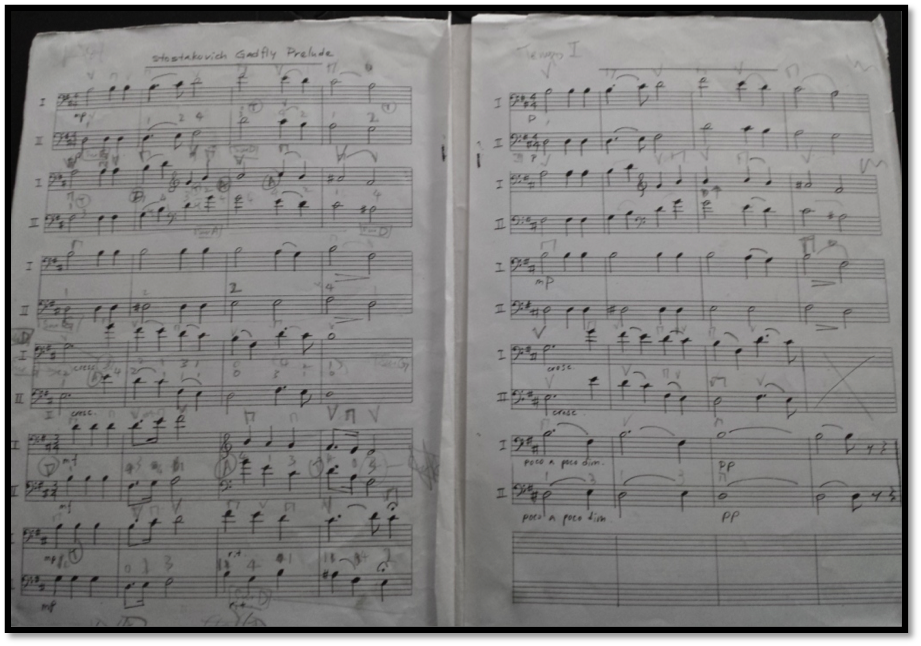
One thing I learned from my days as a choir accompanist in high school was to stick a photocopy of the score on a piece of cardboard paper. This has several benefits:

  • One can mark up the score freely with ease
  • It is more portable
  • It is easier to read without glare
  • It eliminates page turning
  • It stays put in light breeze

This time I used a black cardboard paper as this would be less distracting for the audience.

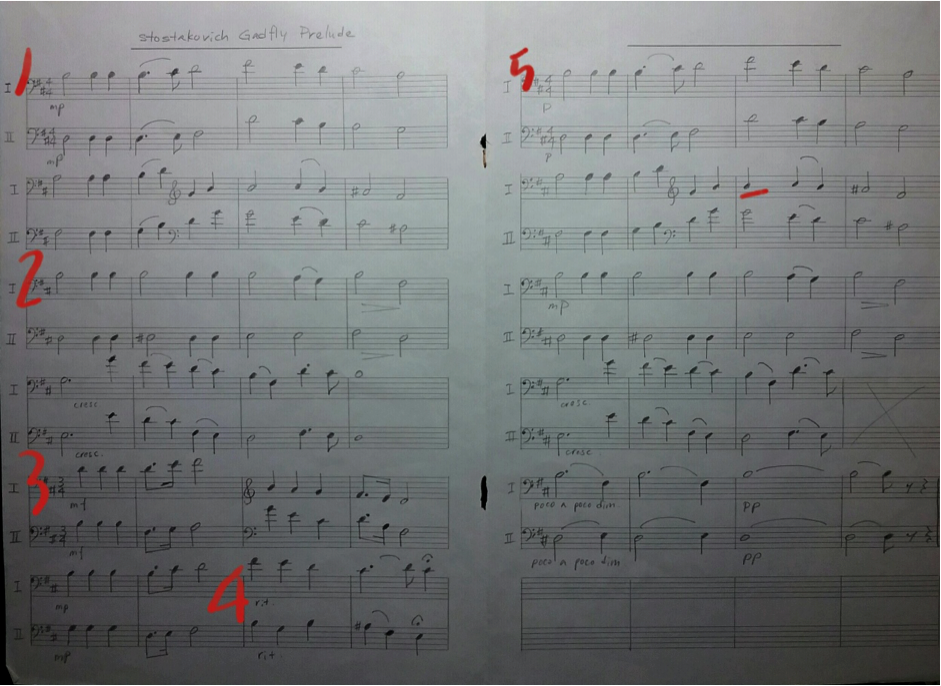
The Practice Score

For the next several months, I practiced the piece for several hours every weekend. I think I might have played the piece at least hundreds of times in total. The most difficult part was having to practice alone for a duet piece. So after I had memorized the piece, I started wearing an earpiece hooked up to my mobile phone and played along with the YouTube video. That turned out to be quite fruitful for several reasons:

  • As Teacher always says “Rule Number One: Whatever happens, don’t stop.” I became more conscious about breaking this rule whenever I had to pause and rewind the video.
  • The style and tempo presented by 2Cellos in this piece was in line with my story. I was able to get into the mood quicker. It also made molding the music into the storyline easier.
  • Playing “against” the sound of the other cello part and more importantly that of the accompanying piano was like playing in a real rehearsal such that I was able to plan out every detail after countless trials. The most critical part starts even before the first note. I would close my eyes and let the piano introduction led me into the mood of the story. Then I would take a deep breath and opened my eyes shortly before the end of the last bar of this piano introduction to prepare for the cello music to start at the following bar.

However, playing with a live person certainly was not the same. I got to experience such differences during my weekly meeting with Teacher. Teacher would point out deficiencies that I was unaware of as it was difficult to listen to my own playing at home. I recalled several hilarious exchanges we had.

Referring to #2 above

Teacher: Play more softly.
Me: What do you mean by more softly? Quantity or Quality?
Teacher: ……
Me: Oh! You mean like beef stew simmering in a pot?
Teacher: (Almost fell off his chair laughing so hard while nodding)

Referring to #3 above

Teacher: Play more cheerfully.
Me: But they are dead
Teacher: They are in heaven now. R…ight? (*Teeth grinding*)
Me: Umm… But they are dead.
Teacher: ……

A major problem surfaced during these weekly practice sessions with Teacher. I was unable to get into the mood like I could at home. And this had caused my playing to practically fall apart. Not being in the same environment and not playing the same cello were part of the reasons. But there was definitely something more crucial at play. Only a week or 2 before the concert day did I figure it out. “What a close call!” I finally suggested to Teacher: “I will follow your lead for the first few notes of each section (#1, #3, and #5 in Figure 2). But after those first few notes, I will ignore you and do my own thing.” Surprisingly this worked like a charm!