We received notice from the music school regarding the arrangement on the day of the concert. There will be a rehearsal at the venue in the morning, then free time in the afternoon before the actual concert in the evening. My immediate reaction was “Oh, no… Where can I go that afternoon?”
Going home would not be a good option for 2 reasons. For one, it would drain quite a bit of energy and concentration hauling the cello back and forth even if I took a taxi. But more importantly, I would be at risk of arriving late at the concert if there was a traffic jam.
What about sitting in a coffee shop or hotel lobby? It’s an economical and logical solution for sure. But I quickly threw out that idea as there would be too much distraction in the surrounding.
As the day of the concert was getting near, I got more anxious not having a solution. I did have another idea but it just seemed crazy. I finally explained this idea to my mom and surprisingly she supported the idea. So at 11 pm before the big day, I made an online room reservation at a hotel which was about 15-minutes walking distance from the venue. Now I had a place to rest during that afternoon before the concert.
I asked my mom to go with me to the rehearsal but not to the actual concert at night. I wanted her to see for the first time what I have been doing for the past few years. And I needed someone to watch over my cello if I needed to step away for a while. But her attending the actual concert would cause more anxiety and distraction for me.
One thing I learned from my days as a choir accompanist in high school was to stick a photocopy of the score on a piece of cardboard paper. This has several benefits:
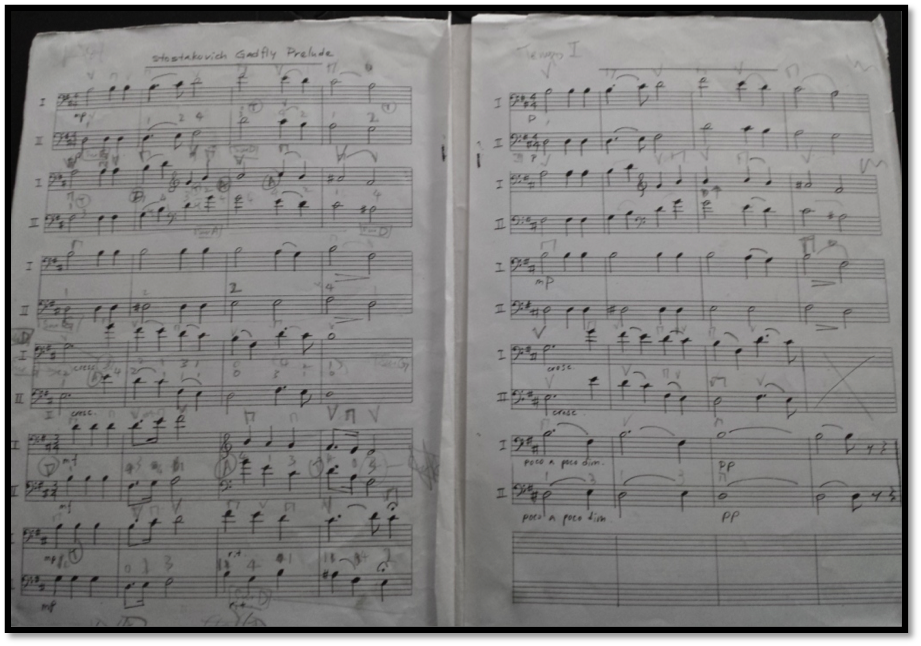
One can mark up the score freely with ease
It is more portable
It is easier to read without glare
It eliminates page turning
It stays put in light breeze
This time I used a black cardboard paper as this would be less distracting for the audience.
The Practice Score
For the next several months, I practiced the piece for several hours every weekend. I think I might have played the piece at least hundreds of times in total. The most difficult part was having to practice alone for a duet piece. So after I had memorized the piece, I started wearing an earpiece hooked up to my mobile phone and played along with the YouTube video. That turned out to be quite fruitful for several reasons:
As Teacher always says “Rule Number One: Whatever happens, don’t stop.” I became more conscious about breaking this rule whenever I had to pause and rewind the video.
The style and tempo presented by 2Cellos in this piece was in line with my story. I was able to get into the mood quicker. It also made molding the music into the storyline easier.
Playing “against” the sound of the other cello part and more importantly that of the accompanying piano was like playing in a real rehearsal such that I was able to plan out every detail after countless trials. The most critical part starts even before the first note. I would close my eyes and let the piano introduction led me into the mood of the story. Then I would take a deep breath and opened my eyes shortly before the end of the last bar of this piano introduction to prepare for the cello music to start at the following bar.
However, playing with a live person certainly was not the same. I got to experience such differences during my weekly meeting with Teacher. Teacher would point out deficiencies that I was unaware of as it was difficult to listen to my own playing at home. I recalled several hilarious exchanges we had.
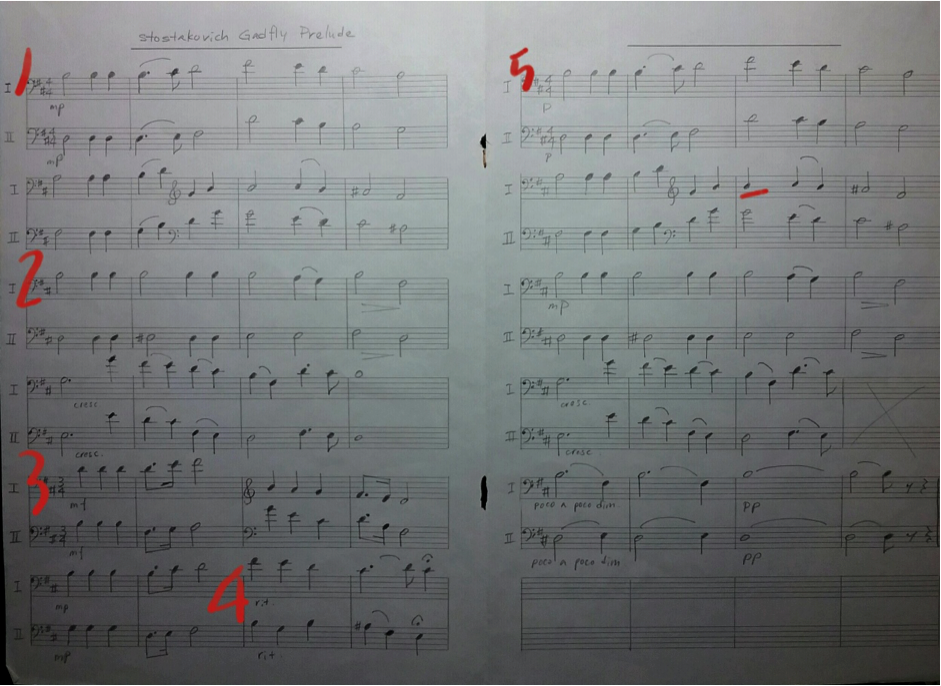
Referring to #2 above
Teacher: Play more softly. Me: What do you mean by more softly? Quantity or Quality? Teacher: …… Me: Oh! You mean like beef stew simmering in a pot? Teacher: (Almost fell off his chair laughing so hard while nodding)
Referring to #3 above
Teacher: Play more cheerfully. Me: But they are dead Teacher: They are in heaven now. R…ight? (*Teeth grinding*) Me: Umm… But they are dead. Teacher: ……
A major problem surfaced during these weekly practice sessions with Teacher. I was unable to get into the mood like I could at home. And this had caused my playing to practically fall apart. Not being in the same environment and not playing the same cello were part of the reasons. But there was definitely something more crucial at play. Only a week or 2 before the concert day did I figure it out. “What a close call!” I finally suggested to Teacher: “I will follow your lead for the first few notes of each section (#1, #3, and #5 in Figure 2). But after those first few notes, I will ignore you and do my own thing.” Surprisingly this worked like a charm!
I returned to my usual tactics to come up with a story. I kept replaying the piece in my head whenever I had free moments like commuting to work, taking a shower, waiting in line at a fast food store or supermarket, etc. Often scattered images would pop up in my head representing certain bars or notes in the piece. And gradually, or sometimes when I was lucky, a series of such images would play like a movie, forming a good chunk of the story.
With a story freshly made up, I described the plot to my teacher animatedly during our weekly meeting.
The story was based on my visit to the Auschwitz Memorial, the former concentration camp site located in Poland, several years ago.
Selected Photo Galleries from the Auschwitz Memorial website (A friendly warning that some of these photos can be quite graphical):
Referring to the number markers on the music score above, the story went like this:
On a gloomy day, long queues of newly arriving inmates dragged their exhausted bodies through the entrance “ARBEIT MACHT FREI” Gate (Photo Gallery A), not knowing their fate.
As the inmates walked towards the stony chamber (Photo Gallery A), some crying in fear while others silently accepting the inevitable, they wondered…Would they be greeted with a much needed shower or the infamous poisonous gas? Unfortunately, for this lot of poor souls, the unthinkable was awaiting them.
Now they found themselves riding joyfully on the fluffy white clouds in heaven, finally free at last.
But then they looked down at the earthly land from above…
The horrific aftermath and suffering left behind by the massacre was overwhelming. In particular, the following scenes from my visit at the camp hit me the hardest:
The location of the camp was chosen for the efficiency of transporting inmates as it was at the center of all the targeted European cities. (Photo Gallery B)
When walking towards the crematorium (Photo Gallery A), the local tour guide whose grandfather was an inmate pointed to a building on the other side of a dividing wall not more than 100 feet away, and said “That’s where the commanding officer of the camp and his family lived. Often his children played on the grounds.”
The facial expressions of the inmates in their photographs on the walls of the hallways. (Photo Gallery B)
[Referring to the underlined note on the score] At the museum hosted in the actual camp buildings, there was a large room where the whole side of the wall is a glass window enclosure. Inside the enclosure was a mountain pile of human hair. In another window enclosure, there was a stockpile of personal belongings such as eye glasses, shoes, hair combs, etc. (Photo Galleries B & C)
Thankfully, Teacher nodded his head and agreed that this story would work well with the piece. “Yay!”
While learning the notes and coming up with the fingerings to play the piece, I did some online research on the side as well. From looking at the comments people posted under that YouTube video, I learned that the piece was actually the “Prelude” from Shostakovich’s film music The Gadfly Suite, Op. 97a.
It’s the first time I had ever listened to a complete film music score in one go. Although the “Romance” from this suite is the most popular piece, the “Prelude” still remains as my favorite to this day.
But… what on earth is “Gadfly”? After some Googling, it turned out the film was based on the novel The Gadfly by Irish writer Ethel Voynich. So I downloaded the novel to my Kindle and made it a mission to read the whole novel the following weeks.
Here’s a 2017 BBC article by Benjamin Ramm about this novel (see reference 1).
It contains a good summary of the story:
“The Gadfly is set in Italy during the revolutionary ferment of the 1830s and ‘40s. The protagonist is a young Englishman, Arthur Burton, who moves to a Catholic seminary after the death of his mother. There he becomes devoted to his guardian and mentor Montanelli, who, unknown to him, is also his biological father. In the company of his childhood sweetheart Gemma, Arthur becomes involved in the Young Italy movement fighting Austrian imperial rule. But he unwittingly betrays his comrades, after his private confession is relayed to the police. He then discovers his family secret, and loses all faith in the church.
Arthur feigns his suicide and escapes to South America, where he endures years of torture and degradation. He returns to Italy in the guise of ‘The Gadfly’, a fearless and revered revolutionary whose true identity is masked. After his capture, he is visited by Montanelli, now a cardinal, who offers him a lifeline. But Arthur, unforgiving and uncompromising, demands that his father renounce the church. Montanelli refuses and condemns his son to death. Arthur, now a Christ-like figure, commands his own execution and forgives the firing squad. At the Corpus Christi mass, Montanelli denounces God’s sacrifice, then dies of a broken heart.”
I don’t even remember how long it took me to finish the novel as I somehow found the writing to be a bit dry, despite many good reviews from other readers. After I finally finished reading the novel, I spent over an hour with my teacher going through the storyline. We dissected the personality of the main character Arthur and his relationships with his father and his love interest. Teacher supplied some historical background and explained the motives behind the actions of the character. “Now, why on earth my teacher always loves to talk about history of this and history of that, I will never understand. It just bores me to death.” Although my teacher liked the story, at the end of our lengthy discussion I still had a hard time liking Arthur and the choices he made.
If I couldn’t relate to or even like the story, I knew for sure I wouldn’t be able to interpret it through music. But my teacher always says it is important for us as students to have a story behind the music we play. “So, now what?”
October 14, 2013. That’s the day when I played cello in front of strangers for the first time at a cello student concert. And why am I writing about this now, almost 6 years later? Strangely enough, to this day, I am still discovering more and more about what I have gained from this experience. Before my memory fails me, I’d better write this down as a keepsake. OK, actually my teacher has been nagging me about the benefits of keeping notes of my study too.
//Checkpoint (1)//
How It All Began
This all started, about 6 months before the concert, when my teacher asked me if I would be interested in participating in the concert. To be honest, performing in public has never been my forte. But I felt I needed a checkpoint at that stage of my cello study. Considering my teacher would be playing together with me on stage, this seemed doable. So during the week after, I spent hours on YouTube every night looking up duet pieces that I might be able to handle technically. But more importantly, a piece that touched me. And that’s when I came across this video, Prelude by Dmitri Shostakovich performed by 2Cellos.
Next, I needed to find the score. At the time I was only able to find a copy of the violin version, Prelude from Five Pieces for Two Violins and Piano. Then some folks in a music forum mentioned one could just transcribe the violin version into cello version by moving it one octave down.
So I went to a nearby stationery store and bought a manuscript notebook for 5 dollars. First, I used a pen to draw the vertical lines to separate the bars and to group the First and Second cello sections. Then I used a pencil to draw each note. It took me several hours that night to finish this.
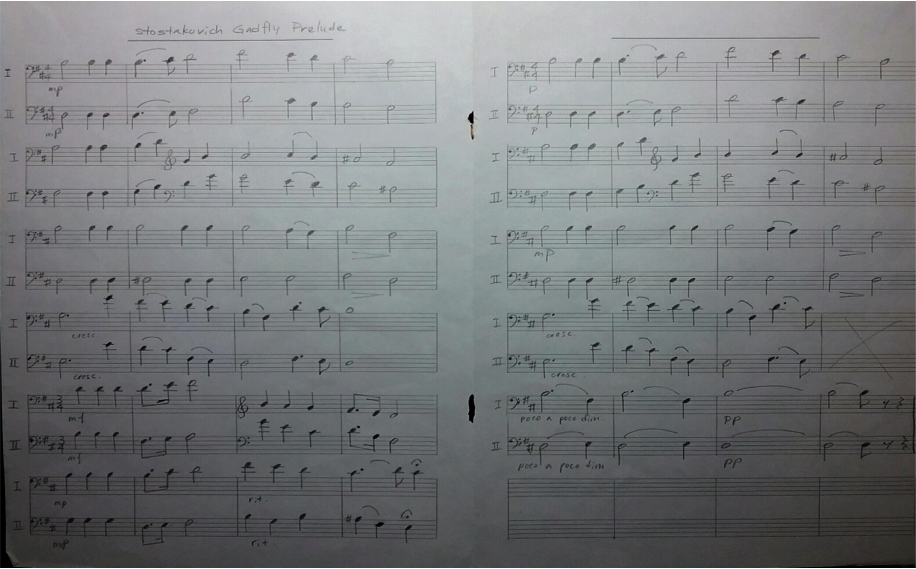
Figure 1. Transcribed Score
With the score in hand, I eagerly went to my next cello class, and showed my teacher the 2Cellos video and the hand-written score. He agreed it was a good choice. But he pointed out that the First cello part didn’t need to be moved down by one octave as it would not sound compatible. “Oops!” Then he suggested I played the Second cello part. “Oh…” Needless to say, I was a bit disappointed. But believing my teacher must have a good reason, I reluctantly replied “O…kay” and moved on.
 the cello suite