Practice, Practice, Practice!

//Checkpoint (4)//

One thing I learned from my days as a choir accompanist in high school was to stick a photocopy of the score on a piece of cardboard paper. This has several benefits:

  • One can mark up the score freely with ease
  • It is more portable
  • It is easier to read without glare
  • It eliminates page turning
  • It stays put in light breeze

This time I used a black cardboard paper as this would be less distracting for the audience.
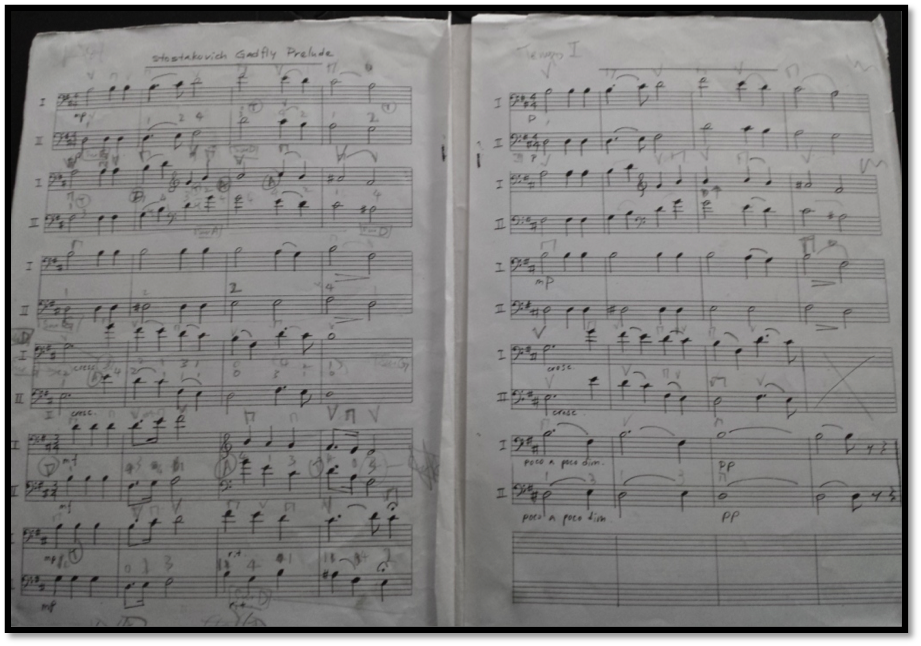
The Practice Score

For the next several months, I practiced the piece for several hours every weekend. I think I might have played the piece at least hundreds of times in total. The most difficult part was having to practice alone for a duet piece. So after I had memorized the piece, I started wearing an earpiece hooked up to my mobile phone and played along with the YouTube video. That turned out to be quite fruitful for several reasons:

  • As Teacher always says “Rule Number One: Whatever happens, don’t stop.” I became more conscious about breaking this rule whenever I had to pause and rewind the video.
  • The style and tempo presented by 2Cellos in this piece was in line with my story. I was able to get into the mood quicker. It also made molding the music into the storyline easier.
  • Playing “against” the sound of the other cello part and more importantly that of the accompanying piano was like playing in a real rehearsal such that I was able to plan out every detail after countless trials. The most critical part starts even before the first note. I would close my eyes and let the piano introduction led me into the mood of the story. Then I would take a deep breath and opened my eyes shortly before the end of the last bar of this piano introduction to prepare for the cello music to start at the following bar.

However, playing with a live person certainly was not the same. I got to experience such differences during my weekly meeting with Teacher. Teacher would point out deficiencies that I was unaware of as it was difficult to listen to my own playing at home. I recalled several hilarious exchanges we had.
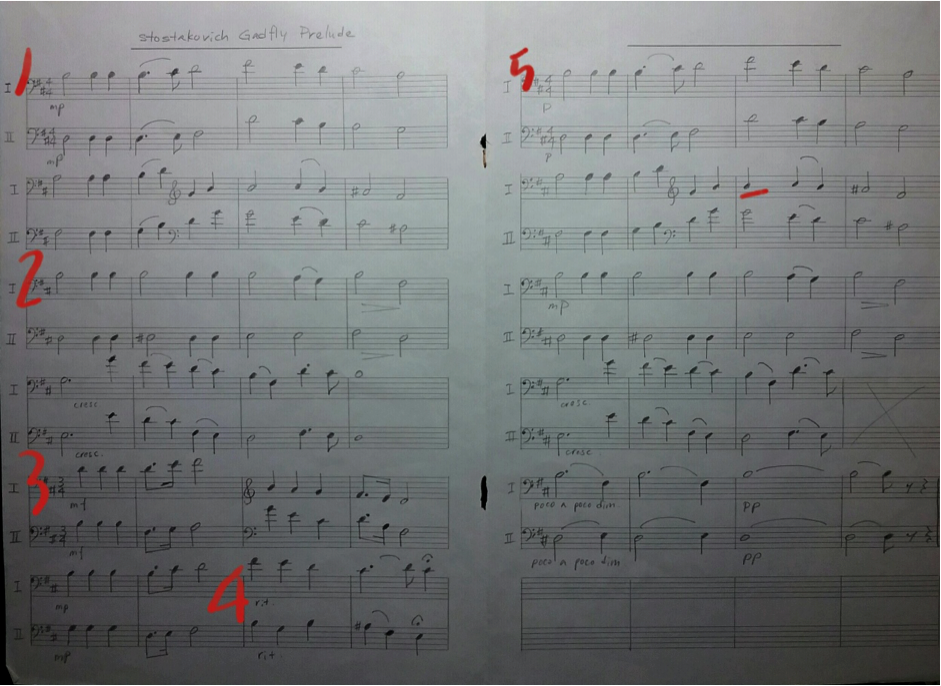
Referring to #2 above

Teacher: Play more softly.
Me: What do you mean by more softly? Quantity or Quality?
Teacher: ……
Me: Oh! You mean like beef stew simmering in a pot?
Teacher: (Almost fell off his chair laughing so hard while nodding)

Referring to #3 above

Teacher: Play more cheerfully.
Me: But they are dead
Teacher: They are in heaven now. R…ight? (*Teeth grinding*)
Me: Umm… But they are dead.
Teacher: ……

A major problem surfaced during these weekly practice sessions with Teacher. I was unable to get into the mood like I could at home. And this had caused my playing to practically fall apart. Not being in the same environment and not playing the same cello were part of the reasons. But there was definitely something more crucial at play. Only a week or 2 before the concert day did I figure it out. “What a close call!” I finally suggested to Teacher: “I will follow your lead for the first few notes of each section (#1, #3, and #5 in Figure 2). But after those first few notes, I will ignore you and do my own thing.” Surprisingly this worked like a charm!
The Swan Challenge: Teacher vs Maisky

//The Cello Lesson Comedy Show (4)//

ABRSM Cello Grade 7 Saint-Saëns: Le cygne (from “The Carnival of the Animals”)
Posted by The Cello Suite (2020)

During my class with Teacher last week…

Me: I watched your cello exam demo video The Swan last night.
Teacher: *Sigh* Told you not to watch my videos…
Me: I was bored. Anyway, you sounded weird in the video.
Teacher: (“Oh, no. Not again…”) Mm… How so?
Me: Just strange. So I dug up Maisky’s video to compare with yours. I know it is not a fair comparison since yours was an exam demo while his was a concert performance. But still…

Camille Saint-Saëns: Le cygne (The Swan)
Mischa Maisky, Boian Videnoff – Mannheimer Philharmoniker

Posted by Mannheimer Philharmoniker (2019)

Me: I watched both videos but I couldn’t describe the difference. So I closed my eyes and just listened to both videos again. Maisky’s tempo was much slower than yours. I assume it is much harder to play in a slower tempo. But the connection between his notes never dropped. Your notes seemed to stay on the surface. But each of Maisky’s notes seem to hit me in the inside, one by one like waves. And I started getting tears welled up in my eyes.

Teacher: Well…

Me: Maisky always says he intentionally exaggerates when he plays. But still, I wasn’t sitting in the concert hall with him playing live a few feet in front of me. How was it possible that I could feel what I felt through a laptop and a cheap earphone!

And sometimes players have to make the details obvious, as Maisky explained: ‘I’m criticised for exaggerating, but I do it on purpose. I don’t play for people who know the music – I imagine the people who are listening to it for the first time. You have to guide them, to show them every change, every decoration. If you try to show 120 per cent maybe they’ll get 75 per cent. But if you only try 90 per cent they won’t get enough. But I might be wrong.’”[1]

Teacher: That’s…

Me: It just looks and sounds strange when one has to dumb down oneself to play a piece. For the exam videos, why not have 2 versions? In one video, you play the piece exactly the way you would if you were playing it in a real concert. In the second video, get someone whose skill level is closer to the actual grade to play the piece, like having someone at grade 3 level playing the grade 1 piece.

Teacher: Err…

So what’s the final score for the challenge? Maisky one. Teacher zero. (Sorry, Teacher.)

PS. Don’t get me wrong. I know Teacher can do it. He once played Bach’s Arioso during class which made me want to cry at each note. It’s so frustrating that others couldn’t experience that from the video.

Reference:

  1. Mischa Maisky: ‘Bach is turning in his grave’. Oct 20, 2014. https://www.elbowmusic.org/post/2014/10/20/mischa-maisky-bach-is-turning-in-his-grave

Storyteller

//Checkpoint (3)//

I returned to my usual tactics to come up with a story. I kept replaying the piece in my head whenever I had free moments like commuting to work, taking a shower, waiting in line at a fast food store or supermarket, etc. Often scattered images would pop up in my head representing certain bars or notes in the piece. And gradually, or sometimes when I was lucky, a series of such images would play like a movie, forming a good chunk of the story.

With a story freshly made up, I described the plot to my teacher animatedly during our weekly meeting.

The story was based on my visit to the Auschwitz Memorial, the former concentration camp site located in Poland, several years ago.

Selected Photo Galleries from the Auschwitz Memorial website (A friendly warning that some of these photos can be quite graphical):

A) Former Auschwitz I site: http://auschwitz.org/en/gallery/memorial/former-auschwitz-i-site/

B) General Exhibit: http://auschwitz.org/en/gallery/exhibits/general-exhibition,2.html

C) Evidence of crimes: http://auschwitz.org/en/gallery/exhibits/evidence-of-crimes,1.html

Referring to the number markers on the music score above, the story went like this:

  1. On a gloomy day, long queues of newly arriving inmates dragged their exhausted bodies through the entrance “ARBEIT MACHT FREI” Gate (Photo Gallery A), not knowing their fate.
  2. As the inmates walked towards the stony chamber (Photo Gallery A), some crying in fear while others silently accepting the inevitable, they wondered…Would they be greeted with a much needed shower or the infamous poisonous gas? Unfortunately, for this lot of poor souls, the unthinkable was awaiting them.
  3. Now they found themselves riding joyfully on the fluffy white clouds in heaven, finally free at last.
  4. But then they looked down at the earthly land from above…
  5. The horrific aftermath and suffering left behind by the massacre was overwhelming. In particular, the following scenes from my visit at the camp hit me the hardest:
    • The location of the camp was chosen for the efficiency of transporting inmates as it was at the center of all the targeted European cities. (Photo Gallery B)
    • When walking towards the crematorium (Photo Gallery A), the local tour guide whose grandfather was an inmate pointed to a building on the other side of a dividing wall not more than 100 feet away, and said “That’s where the commanding officer of the camp and his family lived. Often his children played on the grounds.”
    • The facial expressions of the inmates in their photographs on the walls of the hallways. (Photo Gallery B)
    • [Referring to the underlined note on the score] At the museum hosted in the actual camp buildings, there was a large room where the whole side of the wall is a glass window enclosure. Inside the enclosure was a mountain pile of human hair. In another window enclosure, there was a stockpile of personal belongings such as eye glasses, shoes, hair combs, etc. (Photo Galleries B & C)

Thankfully, Teacher nodded his head and agreed that this story would work well with the piece. “Yay!”

My First Cello

//The Cello Lesson Comedy Show (3)//

When I finally decided to get my own cello some years ago, I asked Teacher for advice on what to get.

Week 1

Teacher: A decent beginner’s cello would cost about X dollars.

Week 2

Me: You’ve gotta be kidding. I tried a couple of cellos at that price range. They felt mushy.
Teacher: 😶 OK. Try something that costs around 2X to 3X dollars then.

Week 3

Me: I went to 4 shops. Nothing sounded right. And you told me the surface of a good bridge should have this dots-looking pattern. I didn’t see it on some of them.
Teacher: 😓 Cellos at this level should be more than adequate for you.
Me: None of them felt right.
Teacher: 💢 FINE. Go for the European wood then. Those would cost around 5X dollars.

Week 4

Me: I found it! But one problem… It costs … 10X dollars.
Teacher: 😱 WHAT?!
Me: When I was at the shop, a young man happened to be trying out this cello. Right when he played the first few notes, I immediately thought, “Wow! It sounds like what I heard on YouTube!”
Teacher: (“Can I strangle this wacko?!”) You can start with a 5X cello and then upgrade in the future when you gain more skills.
Me: This won’t work. I need a cello that can teach me. He will be my teacher when you are not there during my practice at home. It will be inefficient if I use a cello that has less room for growth. And I want to grow with the cello together.
Teacher: … OK. Fine. 🙈

Fortunately, I was able to charge the payment on my credit card as interest-free installments. So, how is my cello today? He is still patiently tolerating my brutal and clumsy moves. Sometimes it feels like I am disappointing him as I may never be able to show what he can really do. Teacher even offered to “open up” the cello for me after watching me struggle all these years. But I refused. Let’s just hope that someday he will finally talk to me.

Set Thy Position Free

//The Cello Lesson Comedy Show (2)//

How to devise fingerings (1)
Posted by Locomotive Music (2020)

Typical start of my cello lesson looks something like this:

Me: I don’t understand your video. First position, fourth position, seventh position? Don’t know what they are. And who cares?!
Teacher: Sigh…

This actually reminded me of the first major blowup during my lesson years ago. At the time, I had been struggling for weeks with the Minuet from Bach Suite No. 1 that was laid out in one of the commonly used student books. No matter how hard I tried, it never sounded right. Then a lightbulb moment popped up. I dug through my pile of CDs and shuffled one into the laptop. At my next class, I slammed a printout onto the music stand.

Me: Why didn’t you tell me?!
Teacher: ?
Me: (Pointing to different notes on the printout using my bow) Why didn’t you tell me one can do THIS, THIS and THAT!
Teacher: …
Me: (Twisting my left hand and fingers on the fingerboard) And one can actually do THIS and THIS!
Teacher: ……
Me: (Waving my arms) THERE IS NO FREAKING RULE! Do you know how much time I had wasted?!
Teacher: Err…  I didn’t know you would reach this point so soon.
Me: (Death Stare) 

Mischa Maisky’s 1999 release of the Bach Cello Suites CD contained a CD-ROM with the CD-Pluscore technology at the time. You can read more about what this program can do from the references below. The coolest thing is the program contained the score edited by Maisky, all the phrasing and fingerings. So what have I learned? Use the most efficient and effective way to produce what you desire. Other than that, no rules. I have now incorporated this thinking into my warmup routine, navigating different notes across the fingerboard using different fingers, twists and turns. This has helped me feel the differences when a note is played using different fingers, and to learn the relationship between a note and its next-door neighbors and distant relatives. Maybe someday in the far away future I will be able to devise my own phrasing and fingerings.

References:

  1. “Johann Sebastian Bach, 6 Cello Suiten”. Mischa Maisky.  CD release 1999. https://www.deutschegrammophon.com/en/catalogue/products/bach-6-suites-maisky-246
  2. “Bach Cello Suites” Gramophone Music Review by Lindsay Kemp. March 2000. https://www.gramophone.co.uk/review/bach-cello-suites-7
  3.  “CD-Pluscore New Media from Deutsche Grammophon”, September 2000. https://www.musicteachers.co.uk/journal/2000-09_cdpluscore_1.html

Stop or Go?!

Prologue

There is hardly any cello playing during my cello lesson with Teacher. Most of the time, we just chat. Sometimes it turns into a debate, not just about music but anything. I often call this a psychotherapy session but a less expensive one. And I suspect that Teacher sometimes finds it amusing to see what load of crap will be coming out of my mouth next.

//The Cello Lesson Comedy Show (1)//

Stop or Go?!

During the early days of my cello study, Teacher tried to teach me the basic bow stroke:

Teacher: “Go.-Stop. Go.-Stop. Go.-Stop…”
Me: “Go.-Stop. Now what?”
Teacher: “Go!”
Me: “But it stopped already!”
Teacher: “Gather energy then GO!”
Me: “But it stopped already!!”
Teacher: (moving my arm) “GO!!!”

Well, that led to one of the darkest hours of my cello study, which is another story to tell some other day. Then recently (many years after that lesson on bow stroke) I got a lightbulb moment.

Me: “I finally figured out what was wrong with your Go-Stop Go-Stop logic.”
Teacher: (with one eyebrow going up) “Oh? Do tell.”
Me: “It’s not Go-Stop Go-Stop. It should be Stop-Go Stop-Go.”
Teacher: (now both eyebrows shot up) …
Me: “With Stop-Go, there is a forward dynamic to the next Stop-Go and so on. And remember Piatigorsky said ‘The tiger before he jumps, he stops.’? So this Stop-Go Stop-Go pattern matches what he said.”
Teacher: “That’s a creative thought.” (Translation: “What a wacko!”)

To this day, neither of us has budged.

Piatigorsky, Master And His Class, with the U.S.C. Cello Master Class in 1972.
Posted by Emanuel Gruber