XV International Tchaikovsky Competition Daily Journal Cello: “All you Need is Love”, an interview of Mischa Maisky Posted by medici.tv (2015)
“I believe what it makes difference between very good musician and really great artist, is someone who succeeds at least sometimes to reach people’s heart.”
“In order to reach people’s heart, music has to come from your heart, and not from your hands, from your instrument or from your mind or computer.”
“No matter what you do in life, if you do it with love, that’s what makes the difference at the end.”
P.S. My own words are redundant here as his wisdom summed up what I have experienced during my concertgoing years. Thank you, Maestro, for teaching me that.
When chatting with folks about Mischa Maisky’s Bach Cello Suites, most people often refer to his 1984 video recordings [1] which I dubbed it “The Tux” version. And frequently during interviews, he explained why he recorded the Bach Suites the second time in 1999:
“My interpretations have never had a revolution,” he explains. “More of an evolution. For instance, when I recorded the Bach Cello Suites for the second time, it was because I heard my first recording in a shop and barely recognized it! There is a certain maturity that comes with age, and sometimes in strange ways.” [2]
And of course we can enjoy his even more recent interpretation in concerts and on digital platforms, including the home-made version in 2020 during the coronavirus lockdown.
Bach Cello Suite Nr 1 in G Major – “home made” Posted by Mischa MAISKY (2020)
But the version that intrigued me the most was a lesser mentioned one. His Bach Cello Suites concert in Tokyo Bunka Kaikan back in 1991. When I found this, I immediately asked Teacher, “What happened to him?” For some mysterious reason, back then I felt his playing was somewhat broken. Teacher explained that musicians usually go through different phases in their career. That reminded me of the episode where Maisky recalled playing for Pablo Casals:
“Perhaps the most frightening thing was to play Bach for him. Frankly, I was a bit depressed by his reaction. “Young man, I personally don’t think that what you do has anything to do with Bach. However, you are so convinced by what you do, that it actually sounds very convincing.” Isaac Stern calmed me down afterwards during lunch, saying that he thought I had received the highest compliment a young cellist could receive from Casals. I now prefer to take what he said as a compliment.” [3]
His “evolution” taught me not to be afraid of change, not to be wary of criticism from others*, even if it means completely letting go of what I possess. I may not be able to play anything decent for a while, sometimes a long while. But that’s OK because I will discover and experience life a lot more along the way, as long as I believe in myself.
* P.S. I might be imagining things. But once I witnessed Maisky shrugging off the cool response from the audience after he finished playing Beethoven Sonata.
Brahms Cello Sonata in E minor with Mischa Maisky and Pavel Gililov. Posted by C. Bechstein (Bechstein1853). From the documentary “Resonances” (2017)
Last year as I spotted this video on YouTube of Mischa Maisky playing Brahms Cello Sonata in E minor, my first reaction was “Wow!”. My second reaction was “Wait! The pianist!” The pianist looked so familiar. So I dug up an old video that I watched many years ago. It’s the same guy!!
Brahms Cello Sonata in E minor with Mischa Maisky and Pavel Gililov. Posted by LOFTmusic. From the documentary “Mischa Maisky – Beyond Words” (2003)
I remember the first time when I watched the 2003 video, I wasn’t very fond of it and asked my Teacher: “How come it sounds so rough?” Now I asked Teacher again why this new 2017 version, which I absolutely adore, sounds so different. Teacher explained nonchalantly, “The 2003 version has youthful fire whereas the 2017 version has the wisdom from life experience. They have a lot to say.”
Do I have a clue what they are actually saying in the video? No, I really wish I do. But I think I am starting to understand what going through life means as I get older myself. At least now whenever I watch a musician play, I have an uncontrollable desire to look very closely if that musician has something to say, even if I don’t know what the actual message is. Sounds silly. But maybe, just maybe, someday I can see what he or she sees.
The Bach Cello Suites, some call them the Bible or Holy Grail of the cello repertoire. But to me, they are just the biggest mystery in the universe.
9 years ago, I bumped into this video recording of the Bach Cello Suites by Mstislav Rostropovich filmed in 1991. What drew me to this recording was not the playing of the Suites itself. It was the comments made by Rostropovich at the beginning of the cycle and before each Suite. After I watched all his comments in one session, all I could utter was “Uh-Oh…”. I didn’t understand a word he said. But I immediately realized I was in big trouble. This set of Suites seemed to be some bottomless black hole beyond the words spoken by Rostropovich.
Title of the commentaries1 in the video:
Introduction Suite No. 1: Lightness Suite No. 2: Sorrow And Intensity Suite No. 3: Brilliance Suite No. 4: Majesty And Opacity Suite No. 5: Darkness Suite No. 6: Sunlight
Today, I still don’t understand Bach’s music. Even more so, I still have a difficult time figuring out Rostropovich’s playing. But as I watched his comment for the Fifth Suite again just now, his words seemed to resonate inside me a little more.
One thing dawned on me during this revisit of the videos. Rostropovich recorded this Bach Cello Suites cycle at Basilique Sainte Madeleine in Vézelay, France. In the Introduction, he recalled his encounter with Pablo Casals. I remember there was a video of Casals playing Bach Suite in a church too. So I looked it up again. Wham! That church was Abbaye Saint Michel de Cuxa in Codalet, also in France. Coincidence?
One day some years ago, Teacher was showing me random videos at our weekly meeting as usual. A black & white video came up and a guy wearing a suit started playing. I screamed, “What the…! There is a 3D voice coming out of this ancient video!!!” Teacher smirked and showed me the guy’s name. That’s how I came to know of a cellist named Gregor Piatigorsky. So I started digging any info about this guy on the internet.
Piatigorsky, Master And His Class, with the U.S.C. Cello Master Class in 1972. Posted by Emanuel Gruber who performed Ernest Bloch’s “Shelomo” in the class.
It was truly fun to see how masterclass was done back then. At one point Piatigorsky urged his students, “Come on, come on. Asks things. I like questions . . . Question is just like Oscar Wilde said, that questions are never indiscreet, only the answers. So you put me in a spot, you know. Ask me anything.” I laughed so hard. I was so happy to hear from the great master that I wasn’t being obnoxious when I asked Teacher all sorts of dumb questions.
There are so many treasures and wisdom in this video that I will leave them for you to discover.
An Afternoon with Gregor Piatigorsky, a documentary made not long before his death in 1976. Posted by producer and director Steve Grumette.
This documentary was so powerful that I watched it once but couldn’t bring myself to watch it again. All I can say is it has made the most profound imprint in my psyche, guiding my journey with the awareness of the untouchables and the reality.
I read this on and off during commute for several months. It gave you a glimpse of different moments of his life in his own words. To me, the most valuable part is illustrating how musicians of his generation struggled at the time.
Brahms / String Quartet No. 2 in A Minor, Op. 51, No.2 Richard Strauss / String Sextet (from Capriccio), Op. 85 Ng Cheuk-yin / Let There be Light (World Premiere) Beethoven / String Quartet No. 9 in C, Op. 59, No. 3
I spotted a flyer about this concert while waiting for admission to a previous Hong Kong Sinfonietta in the City Hall foyer. I wondered, “How would seeing these players in a group of 4 be different from seeing them in an orchestra?”
Three of the players were principal or assistant principal players in the Orchestra. Seeing their familiar faces but in a smaller setup was both soothing and refreshing. The first question I jotted down in my notes to ask Teacher was “How come the cellist was not sitting on the far right like in the orchestra?”. I forgot what Teacher’s answer was though 😛
With less players on stage, I could take more time to observe each player and the exchanges among them. One thing that stood out to me was the girl in red, second violinist Selena Choi. I remember liking her energetic performance and the distinct sound of her violin.
What surprised me the most was the intensity of a quartet could be even higher than a full orchestra. And it was quite fascinating to watch the interaction between the individuals, both the musical exchanges and body language.
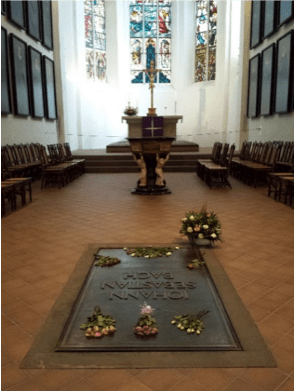 St. Thomas Church, Leipzig, Germany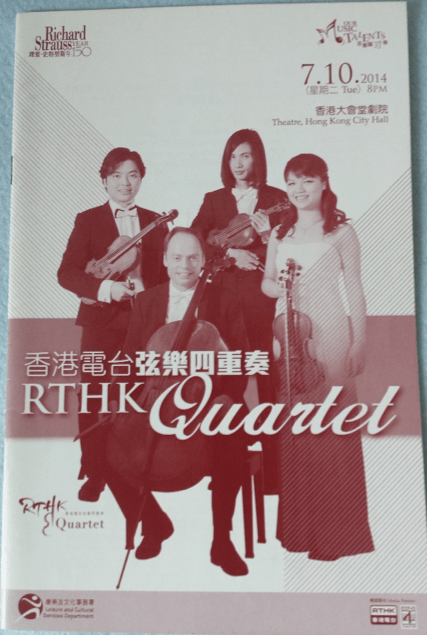
 the cello suite